


TOUR TAMBOPATA 5 DAYS / 4 NIGHS
In the Amazonian region of Madre de Dios, Tambopata National Reserve unveils its richness in the form of colors, sounds, heat and life.
Mammals, birds, reptiles and butterflies are abundant; thousands of species of trees and flowers greet visitors on trails; and aquatic creatures in their natural habitat display their curiosity, even posing for the camera on occasion. Tambopata is the perfect place to discover the rainforest and fall in love with it forever.

DAY 1: We leave Cusco at 9:00 p.m. along the Interoceanic route to the city of Puerto Maldonado. We will travel by comfortable private transportation, throughout the night and arrive the next day at 6:00 a.m. Upon arrival we transfer them to the Monte Amazonico offices.
DAY 2: Upon your arrival at the airport or bus station, our team will warmly welcome you and transfer you to the Monte Amazonico Lodge office for important information about your tour. From there, we will take a boat for an hour to our lodge. After settling into your respective rooms, you will have an introductory hike through the dense tropical forest guided by a local expert. During the hike, you will see a variety of trees, some of which are more than five hundred years old, and observe various species of wild animals, including toucans, orioles, parrots, monkeys, snakes, butterflies, and more. This will be your chance to experience the magic of the Amazon Rainforest within the Tambopata National Reserve, which is protected under Peruvian laws. After lunch, we will visit “Monkey Island,” located in front of our lodge across the Madre de Dios River, where you’ll see different species of monkeys, such as brown capuchin, squirrel monkey, saddleback tamarin, and white capuchin. Afterward, we will return to the lodge for dinner, and in the evening, we’ll search for caimans that are usually found on the banks of the Madre de Dios River.
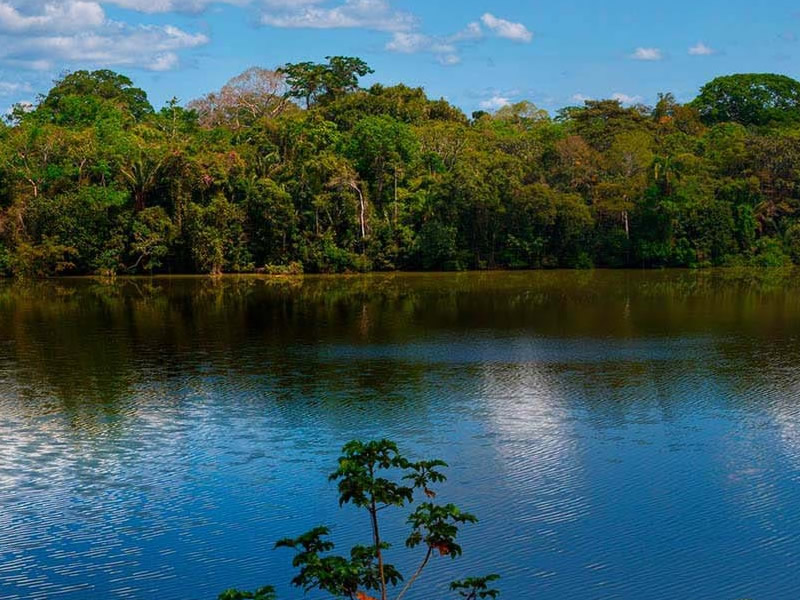
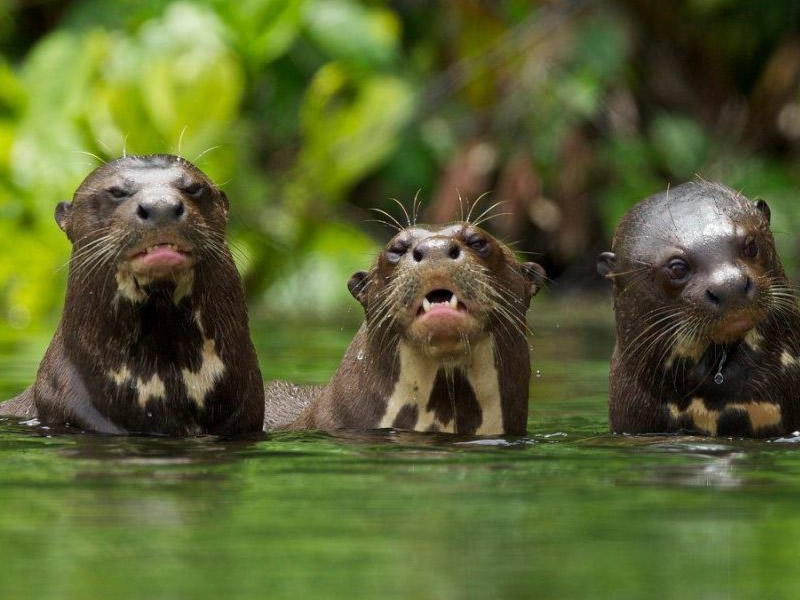
DAY 3: After an early breakfast, we will take a short boat ride to the entrance of Lake Sandoval. After checking in at the checkpoint, we will walk approximately 3 kilometers (2 miles) to Lake Sandoval, which is one of the largest in the Tambopata National Reserve and home to piranhas. After a pleasant walk, our guide will row us across the lake to observe a variety of bird and monkey species, including Hoatzin cormorants, Jacanas, puma herons, eagles, howler monkeys, squirrel monkeys, black capuchins, tamarins, and sloths. With any luck, we may even spot the family of giant river otters, which are almost two meters long and endangered, or the largest alligator on record, which measured over 4 meters long. We will then return to the lodge to enjoy a typical lunch. In the evening, we will take a night walk to appreciate the diversity of insects, amphibians, reptiles, and other nocturnal animals. Afterwards, we will have dinner and rest.
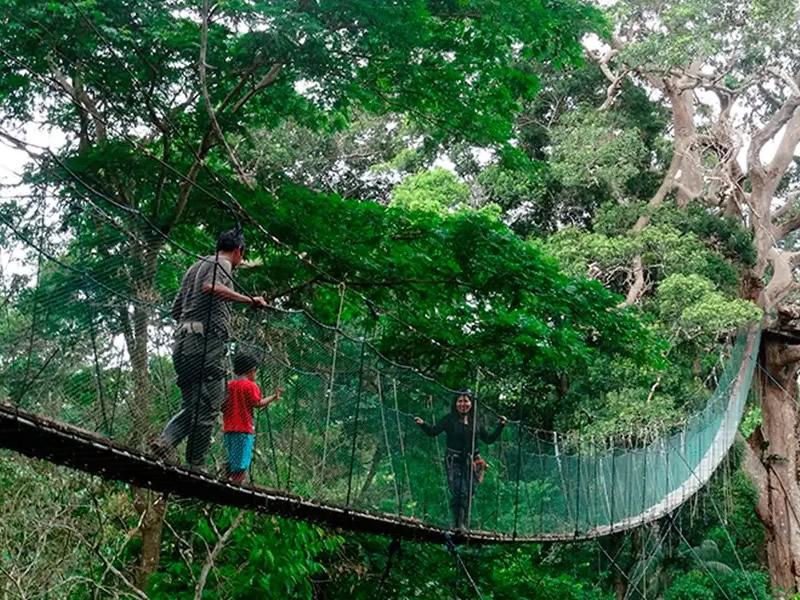
DAY 4: At 5:30 a.m., we will start our morning in the jungle with the Canopy Walk-Way, which will allow us to see the rainforest from a different perspective. At about 30 meters high, the bridges will enable us to appreciate nature from a high altitude, giving us a panoramic view of the Rio Madre de Dios. From the platforms, we can observe different species of birds such as toucans, macaws, tanagers, orioles, and much more, making it a wonderful experience. After breakfast, we will prepare for an adrenaline-filled activity on the trees at more than 30 meters high. We will do the zip-line, and for this activity, we will have an instructor guide who will give us a talk about how to use the safety harness during the zip-line activity. Feeling the rush of gliding through the trees, the experience will stay with you forever. There are two cables that support more than 3 tones. We will return to the Lodge for lunch and rest. In the afternoon, the challenge is to cross the Madre de Dios River kayaking. On the way, we can appreciate the fascinating sunset. Then, we can go artisanal fishing in the Madre de Dios River. With a little patience, we will see some fish species such as catfish.
DAY 5: Breakfast and return to the city, transfer to bus station. From Puerto Maldonado We return to Cusco by private transportation.
INCLUDED:
- Transportation public bus: Cusco – Puerto Maldonado – Cusco
- Hosting Service
- Specialized bilingual guide
- Private Transport (bus station – Lodge – bus station)
- Food (lunch, dinner, breakfast)
EXCLUDED:
- Additional Services
- Insurance
- Bar consumption (alcoholic beverages)
- Entrance fees (Tambopata National Reserve US$ 20.00)
YOU MUST BRING:
• We recommend bringing mosquito repellent, a flashlight, binoculars, personal items, sunscreen, hiking shoes, long shirts, and pants.
Tambopata National Reserve is a Peruvian nature reserve located in the southeastern region of Madre de Dios. It was established on September 4, 2000, by decree of President Alberto Fujimori. The reserve protects several ecosystems of the tropical rainforest for the preservation of such forest and the sustainable use of forest resources by the peoples around the reserve.
Geography
Tambopata National Reserve is located south of the Madre de Dios river, in the province of Tambopata, region of Madre de Dios. It reaches the border with Bolivia to the east and borders with Bahuaja Sonene National Park to the south.
The area consists of forested hills and plains, with elevations ranging from 200 to 400 m above sea level. The area presents swamps, oxbow lakes and meandering rivers; the main rivers in the reserve being the Tambopata, Malinowski and Heath rivers.
Climate
The annual mean temperature in the area is 26 °C, with a range between 10° and 38 °C. The lower temperatures are caused by cold winds of antarctic origin; these cold waves occur in June and July. The rainy season occurs between December and March.
Ecology
Tambopata National Reserve protects an area of rainforest, which belongs to the moist and wet subtropical forest according to the Holdridge life zone classification.The reserve is of ecological importance as it is part of the Vilcabamba Amboro wildlife corridor, which extends into neighboring Bolivia.
Flora
Vascular plants are represented in the reserve by 1713 species in 145 families. Among the species found in this protected area are: Virola surinamensis, Cedrela odorata, Oncidium spp., Bertholletia excelsa, Geonoma deversa, Epidendrum coronatum, Iriartea deltoidea, Celtis schippii, Spondias mombin, Mauritia flexuosa, Cedrelinga cateniformis, Hymenaea courbaril, Ficus trigonata, Croton draconoides, Inga spp., Attalea tessmannii, Calycophyllum spruceanum, Swietenia macrophylla, Couroupita guianensis, Socratea exorrhiza, Hura crepitans, Manilkara bidentata, Hevea guianensis, Guadua weberbaueri, Ceiba pentandra, etc.
Fauna
Among the mammal species found in the reserve are the jaguar, the puma, the ocelot, the collared peccary, the giant otter, the Peruvian spider monkey, the Hoffmann’s two-toed sloth, the capybara, the tufted capuchin, the white-lipped peccary, the marsh deer, the red brocket, the brown-throated sloth, the black-capped squirrel monkey, and the South American tapir, among others.
Some of the species of fish present in the reserve are: Prochilodus nigricans, Potamorhina latior, Brachyplatystoma flavicans, Piaractus brachypomus, Brycon spp., Schizodon fasciatus, etc.
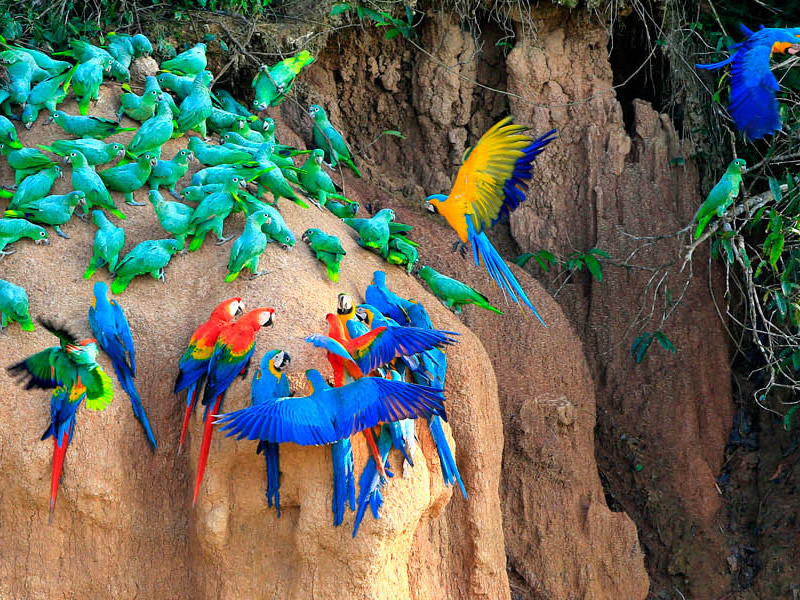
Some species of birds present in the reserve are: the harpy eagle, the white-necked jacobin, the scarlet macaw, the rufescent tiger heron, the king vulture, the roseate spoonbill, the crested eagle, the razor-billed curassow, the blue-and-yellow macaw, the variegated tinamou, the sunbittern, the red-and-green macaw, the horned curassow, the golden-tailed sapphire, etc.
BOOK NOW
